



real hardware, real weight
bassBox
€44,99
€59,99save 25%
VST3AU
bassBox is a sample-based bass instrument loaded with 141 presets — every single one multisampled from real hardware. Subs, stabs, reeses, warps, wide detuned monsters. If it has to move air, it's in here.
Nothing modelled, nothing emulated. Every preset was played into a Yamaha DX7II (plus expansion card), a Roland Jupiter X, a Roland JV-1080 and an Oberheim OB-6, then captured across 21 zones per patch so it actually tracks from C1 to C5 instead of falling apart two octaves up. 24-bit, 44.1kHz, stereo. Real machines, real weight.
🔊 Features
- 141 PRESETS — banked by the machine they came from. DX7II (59), Jupiter X (30), JV-1080 (28), OB-6 (24).
- 21 ZONES PER PRESET — properly multisampled, so it tracks the whole keyboard instead of stretching thin two octaves up.
- CHARACTER — ages the sound instead of distorting it. Turn it up and the bit depth drops away, the top end rolls off, and a soft saturation glues what's left back together.
- DRIVE — the aggressive one. Shoves up to 6dB into the saturator and pulls some back out the other side, so it reads as cranked rather than just fuzzy. Gentle through the bottom half, properly mean at the top.
- FILTER — cut the top off or sweep it open.
- ECHO + TIME — tempo-synced delay when you want movement.
- WIDTH — mono to stereo. The sub stays tight and centred, the top spreads out.
- ADSR — attack, decay, sustain and release with millisecond readouts. Tight stab or long sustain, your call.
- GLIDE — mono-synth portamento. Slide into every note.
- TRANSPOSE — octave up, octave down, instantly.
- PRESET BROWSER — star your favourites and get straight back to them. Resizable UI.
- LOW CPU — big low end, small footprint.
Compatibility: VST3 / AU for Windows 10+ & macOS 10.13+. Intel and Apple Silicon. Works in any DAW that loads VST3 / AU (Ableton, Logic, FL Studio, Bitwig, Studio One, etc.).
Programmed, then sampled
Many of the sounds in bassBox were programmed from scratch on the machines themselves — oscillators, filters and envelopes dialled in by hand — and some are classic factory sounds that earned their place. Every one of them was then multisampled across 21 zones, recorded straight off the hardware. Nothing modelled, nothing emulated.
100% royalty-free. Use these sounds in your own releases — put them in a track, sign it, sell it. No clearance, no extra fees, nothing to report.
All trademarks are the property of their respective owners. belterbox is not affiliated with or endorsed by Roland Corporation, Yamaha Corporation or Oberheim. Hardware names are used only to describe the sound sources sampled for this instrument.
pick your box
2 plugins
bassBox + chordBox
€78,99 €84,98
add both →
best value
all 7
the belter bundle · incl. the free sample pack
€129 €209,94
save €80,94 →
3 or more build your box from €85,00 pick & save ↓
- instant download after checkout
- works in all major DAWs (VST3 · AU)
- license key waiting in your download portal. activate in your DAW
how to install & activate
1. after checkout you get an instant download link by email (check spam too). that link opens your download portal.
2. in the portal, grab the installer and your license key. the key is the .txt file sitting right next to it.
3. Mac and Windows both have their own installer — run it, then rescan your plugins in your DAW.
4. paste the license key when the plugin asks for it on first load.
need a hand? hit support, we usually reply within a few hours.
system requirements
macOS: 10.13 High Sierra or later. Intel and Apple Silicon. VST3 / AU.
Windows: Windows 10 or later (64-bit). VST3.
Both: 4GB RAM and up, and around 3GB of free disk space — these are real samples, not modelled. Works in any major DAW.
hear it
141 basses. one click to hear it.
every preset multisampled from real hardware — DX7II, Jupiter X, JV-1080, OB-6. press play and feel the floor go.
dancefloorfilla
chesthitter
makeahit
warp_bass
progbeast
stussybass
141 Presets. All Real Hardware.
Four machines, 141 presets. A Yamaha DX7II with its expansion card for the glassy digital subs. A Roland Jupiter X for the wide, detuned reeses. A Roland JV-1080 for the '90s rave weight. An Oberheim OB-6 for the fat analog stabs. Every patch captured across 21 zones so it tracks properly the whole way up the keyboard — no stretched samples, no artefacts two octaves from the root. Banked by machine so you always know what you're reaching for.
Simple Controls. Serious Low End.
Six knobs across the strip and you're playing. FILTER shapes it, ECHO and TIME move it, WIDTH takes it from dead-centre mono out to full stereo without losing the sub. Then the two that do the damage, and they pull in opposite directions. DRIVE is the aggressive one — it shoves level into the saturator and pulls some back out after, so it reads as cranked rather than just fuzzy. CHARACTER ages it instead: the bit depth drops away, the top end rolls off from 20k down to 5k, and a soft glue pulls what's left together. It's level-matched, so it never gets louder, it gets older. Both sit at zero until you reach for them. Want to go deeper? The edit panel opens up full ADSR with millisecond readouts, GLIDE for portamento, and TRANSPOSE for octaves. Everything sits on one panel.
from feed to DAW
out in the wild
real producers putting belterbox to work.
take the tour
every knob, explained
tap a number to find it on the plugin.
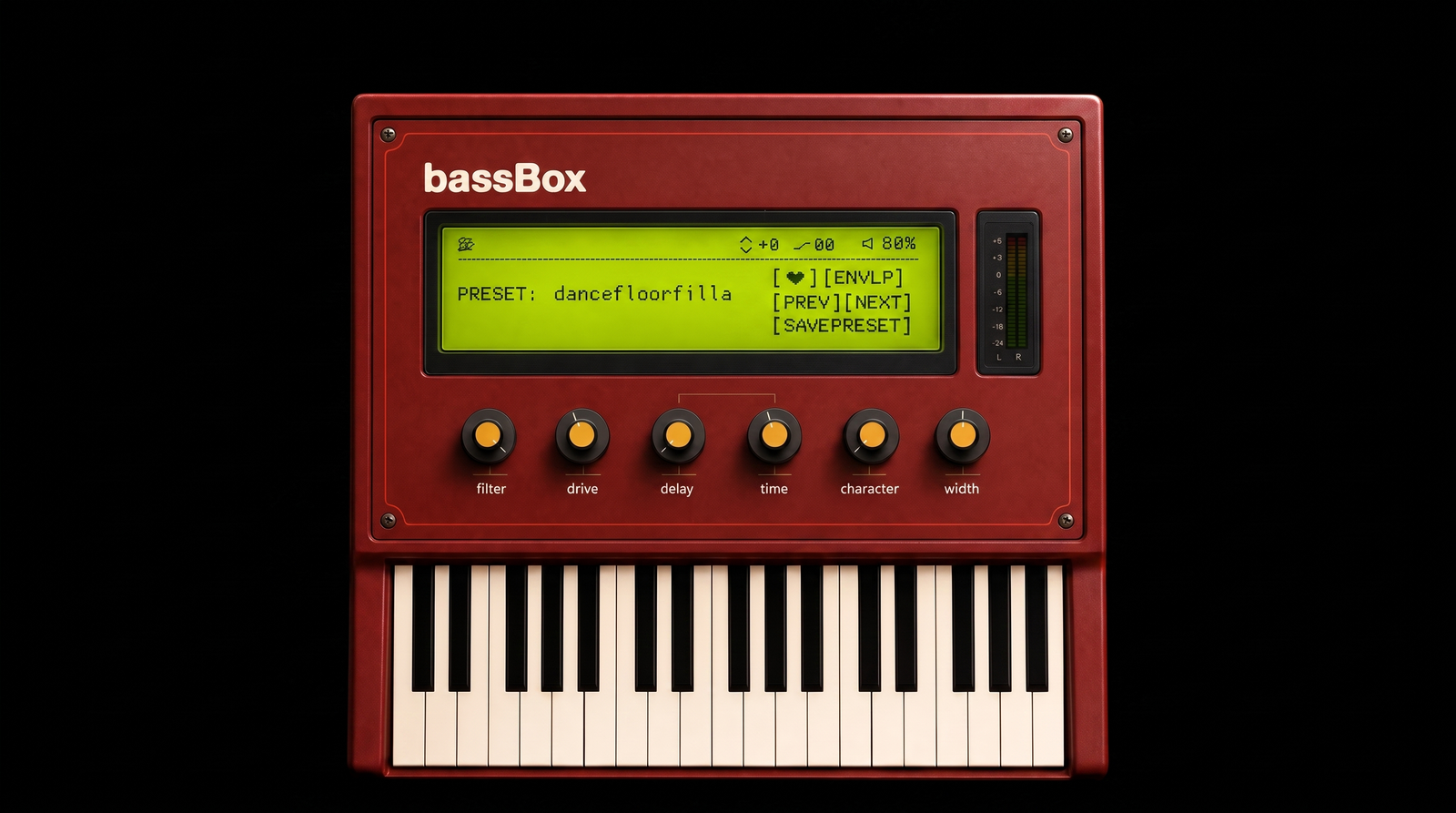
Transpose: Octave up, octave down, instantly.
Glide: Mono-synth portamento. Slide into every note.
Volume: Output level for the whole instrument.
Favourite: Star the ones you keep coming back to. One click to find them again.
Envelope: Attack, decay, sustain, release — with millisecond readouts. Tight stab or long sustain.
Preset browser: 141 presets, banked by the machine they came from. PREV and NEXT walk you straight through.
Filter: Cut the top off or sweep it open.
Drive: The aggressive one. Shoves level into the saturator and pulls some back out, so it reads as cranked rather than just fuzzy.
Echo + Time: Tempo-synced delay when you want movement.
Character: Ages the sound instead of distorting it. Bit depth drops, the top rolls off, soft saturation glues it back together.
Width: Mono to stereo. The sub stays tight and centred, the top spreads out.
- 1Transpose: Octave up, octave down, instantly.
- 2Glide: Mono-synth portamento. Slide into every note.
- 3Volume: Output level for the whole instrument.
- 4Favourite: Star the ones you keep coming back to. One click to find them again.
- 5Envelope: Attack, decay, sustain, release — with millisecond readouts. Tight stab or long sustain.
- 6Preset browser: 141 presets, banked by the machine they came from. PREV and NEXT walk you straight through.
- 7Filter: Cut the top off or sweep it open.
- 8Drive: The aggressive one. Shoves level into the saturator and pulls some back out, so it reads as cranked rather than just fuzzy.
- 9Echo + Time: Tempo-synced delay when you want movement.
- 10Character: Ages the sound instead of distorting it. Bit depth drops, the top rolls off, soft saturation glues it back together.
- 11Width: Mono to stereo. The sub stays tight and centred, the top spreads out.
the reviews
what producers say about belterbox
reviews from producers worldwide, across all our plugins
-
★★★★★
Great plugin already made some tracks with it!
 on chordBox
-
★★★★★
Awesome sounds in this plugin
 on garageToolz
-
★★★★★
A must have
 on pianoToolz
-
★★★★★
Works good
 on phatPress
-
★★★★★
Honestly, your plugins are so simple and really easy to navigate, yet they're really effective and take productions to the next level. Thanks again 😀 you've ...
on garageToolz
-
★★★★★
I'm very pleased with phatPress and the 90s drum sample pack. Love that you're bringing back the 90s sound!
on phatPress
show all 51 reviewsshow fewer
-
★★★★★
I just purchased all of your products would love to get in on this one asap.
on phatPress
-
★★★★★
Got garagetoolz and it’s been amazing, will definitely be getting this one🫡
on garageToolz
-
★★★★★
Solid, some really nice and crisp sounds in this, using it a lot lately
on pianoToolz
-
★★★★★
Amazing plugin, simple and effective giving the classic sound you need
on pianoToolz
-
★★★★★
Great product, exactly as it's described. Very nice sounding plugin.
on garageToolz
-
★★★★★
Already bought chordBox & the new piano plugin, absolute weapons
on chordBox
-
★★★★★
It works — thanks for your help. Your plug-ins are brilliant!
on pianoToolz
-
★★★★★
Downloaded the plugins the other day, sounds are immaculate 👀
 on Belter Bundle
-
★★★★★
Just bought the 2 plug in already so good take my money lol
on garageToolz
-
★★★★★
Perfect house & garage sounds. Fast inspiration every time!
on garageToolz
-
★★★★★
will be picking up immediately, love your other plugins! 🔥
on garageToolz
-
★★★★★
first plugin I’ve see in years I could actually be about 🤔
on chordBox
-
★★★★★
Today I ordered your garageToolz software. Amazing stuff!
on garageToolz
-
★★★★★
Simple yet clear UI, catchy sounds, highly recommended!
 on 90sDrumz
-
★★★★★
Deadass smacking phatpress on anything 10/10 plugin dr
on phatPress
-
★★★★★
Just got it. Will check tonight. Love 808/909 drums
on 90sDrumz
-
★★★★★
Looking forward to using your plugins. Great work!
on chordBox
-
★★★★★
@belterbox.wav Bought it! Love Garagetoolz also💪🏽
on garageToolz
-
★★★★★
Love this plug-in! Lots of great sounds in here
on garageToolz
-
★★★★★
First of all, I'm very happy with garageToolz
on garageToolz
-
★★★★★
Hey guys, I have every plug-in and love them
on pianoToolz
-
★★★★★
I purchased garageToolz which is excellent!
on garageToolz
-
★★★★★
Hey, I want the pianoToolz — it's amazing
on pianoToolz
-
★★★★★
Just bought this man, love the sounds 👏
on phatPress
-
★★★★★
Made a speed garage tune with this VST
on garageToolz
-
★★★★★
Im gate keeping this hard, I love it
on garageToolz
-
★★★★★
I’ve bought the plugin sound dope !!
on garageToolz
-
★★★★★
Just bought the vst, I love it
on chordBox
-
★★★★★
Best fing… pluuugin… I fink 🔥
on garageToolz
-
★★★★★
i am in love with this plugin
on Belter Bundle
-
★★★★★
Thank you guys, you da best
on chordBox
-
★★★★★
best vst ive bought by farr
on chordBox
-
★★★★★
First every plugin bought!
on phatPress
-
★★★★★
I've been loving chordBox
on chordBox
-
★★★★★
Best plugin I've bought!
on 90sDrumz
-
★★★★★
Goated plug-ins 🫠
on Belter Bundle
-
★★★★★
Min9th goated too
on chordBox
-
★★★★★
Phatpress goated
on phatPress
-
★★★★★
Love ur plugins
on garageToolz
-
★★★★★
10/10 plugins
on phatPress
-
★★★★★
The 808 sick
on 90sDrumz
-
★★★★★
easy to use
on chordBox
-
★★★★★
Love it 🥰
on 90sDrumz
-
★★★★★
Use it in (almost) every project, for quick inspiration!
on pianoToolz
-
★★★★★
in love with this, found it via instagram
on garageToolz
more belters
you may also like